Wednesday, December 15, 2010

HOLIDAY APPETIZERS


THE HOLIDAYS BEET ME!
The best of the holidays is the gatherings of loved ones, friends and family.
Feeding them is another story.
But here are two ideas that are really rather simple, although they do require some cooking ahead, and are quite savory. You'll have folks singing your praises rather than carols.


TAKE IT FROM TV
Roanoke's WSLS 10 has had me on its noon time show, OUR BLUE RIDGE, several times the last few months.
Last week, I demonstrated two recipes. The first was for an awesome spread made with artichokes and goat cheese, or chevre. It's a step beyond the typical artichoke, mayo/sour cream and cheese dip, and is a bit healthier. Roast frozen artichoke hearts first with herbs, and you'll find folks in your kitchen drawn to the aromas. Then, while it's hot, add the chevre. Serve bubbling hot from the oven on warm baguette slices or crackers, and you've got one mighty hors d-oeuvre.


GIFT PACKAGES
A beautiful little package of roasted beet, chevre and rosemary appetizers is also one of my favorite things to serve from THE NEW BLUE RIDGE COOKBOOK.
Roast those ruby red beets, defrost a package of puff pastry, chop some fresh rosemary and slice a log of chevre, then assemble quickly. A bit involved, yes, but really rather simple. Get your guests involved, and what a merry way to spend time in the kitchen - with tasty rewards!
Go to this link for the recipes already printed. And please watch for more helpful hints.


Thursday, December 2, 2010

APPLE PANCAKES


WEEKEND BREAKFASTS
One of my best presents I received for Christmas last year was home delivery of the Sunday NEW YORK TIMES. I relish curling up on the sofa and diving into the politics, fashion, movies and book reviews, while downing a huge pot of coffee, and when it's the season, having a nice roaring fire going in the fireplace.
A nice breakfast treat just adds icing on my cake. And I am a fool for anyone who wants to cook me breakfast. My husband, bless his heart, has finally mastered eggs-over-easy. But that's about the end of his repertoire.
With Pink Ladies and Golden Spices in my larder, and apples a favorite of the hubby, I tried recently to also make his day by making a breakfast version of an apple pandowny.
Buckwheat is a favorite of mine, especially with maple syrup. Whenever I find stoneground grits, there will usually be pancake mixes available, too. So I've got a stash of buckwheat pancake mixes in the extra fridge in the garage.


APPLES & BUTTER
The small, six-inch cast iron skillet that was my grandmother's brings back such sweet memories every time I use it. And isn't that what the weekend's more relaxed time should be about? Conjuring up memories of a loved one while stirring up something yummy?
I peeled, cored and thickly sliced two apples. I also used an additional small skillet so that I could cook two pancakes at a time, and melted a pat of butter in each.
The apples slices looked like a pinwheel when added to the skillets. I cooked them over a low heat so that they would not brown too quickly before softening up, then flipped each slice over.
Then I mixed up the pancake batter, and slowly poured it over the apple slices, again over low heat.


FLIPPED
I'll confess that flipping the pancakes didn't work with one. The trick is that, just as with regular pancakes, you must wait until the bottom is fully cooked. Usually you can see what looks like popped bubbles, or tiny craters, that indicate that the batter is cooked through. And that's when you can successfully slide your spatula under the apples and batter, and then flip them over.
Good luck. I've had success with that two out of the four times I've made them!
But let me tell you......no matter if it's pretty on top or not, these pancakes are just divine. We splurge with real maple syrup from either Whitetop Mountain in VA, or from Maple Springs Farm near Burnsville, NC.

Tuesday, November 23, 2010

PUMPKIN EATERS!


"They really love 'em," the farmer yelled over to me as he flung yet another pumpkin from his truck with a shovel. These Halloween rejects were quite the treat for these pasture-raised mommas and their calves.
At this time of year, Ashe County roads are humming with huge trucks hauling Christmas trees, Fraser firs, cut during the cold snap of November. Farmers markets are full of beautiful round cabbage heads and winter squash, as well as the start of Christmas decorations.
At Zydeco Moon Farm & Cabins, we were treated to some of Sally's zesty tender greens she's growing in a new hoop house. Her CSA patrons will enjoy more greens all winter long with a clever new growing system that re-purposes gutters. Drainage holes were drilled in the bottoms and then they were filled with soil. What a great growing environment in the greenhouse during the winter!

Ashe Co. Church Marquee. . . . We don't need more to be grateful for; we need to be more grateful. Happy Thanksgiving, y'all.


PUMPKIN IN THE OVEN........
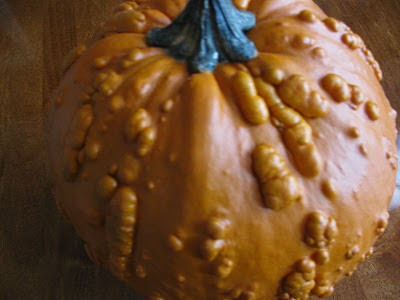
So what if it's full of warts and getting old......Like me, it's still full of flavor and usefulness!
De-seeded, my Halloween pumpkin will be roasted, and I'll use the puree for either a soup or a pie.
My friend from Chapel Hill, Nancie McDermott, author of SOUTHERN PIES and SOUTHERN CAKES and several other cookbooks, writes that she prefers to use canned pumpkin in her pies, for the fresh pumpkin can be rather watery when cooked down. Purists like Barbara Kingsolver, in ANIMALS, VEGETABLES & MIRACLES, recommends cooking with fresh pumpkin.
Frankly, I think whatever you have time for is just dandy. If the pumpkin's flesh is too watery when roasted, it will be perfect for soup. So keep some cans of pumpkin puree to use with pies or muffins in your pantry!
Ditto for pie crusts. Nancie and I shared a secret at a recent Pie Contest where she was signing books at Quail Ridge Books.
We keep a stash of pie crusts in the fridge or the freezer. Not the homemade kind. The boxed, rolled up pie pastry for me, the crusts in the tins for her.
If time is limited, wouldn't we rather have pie, even if we don't use not made-from-scratch pastry?
Enjoy your Thanksgiving gatherings of loved ones and eating!


Tuesday, November 9, 2010

STOKES PURPLE SWEET POTATO

I like the color purple.
Folks who know the Carolina Foodie often see her wearing purple.
So when I saw PURPLE SWEET POTATOES at the State Farmers Market in Raleigh, I had to have them. I wanted to EAT PURPLE!
I had heard that NCSU had been working in their micro-propagation program with the Saura Pride Co in Stokes County, trying to rid a purple sweet potato of any possible viruses. The fact that they were now for sale meant success.

STOKES PURPLE
That's its official name, the Stokes Purple, and it has an interesting story.
After retiring from a state job, Mike Sizemore of Walnut Cove decided to farm some land he owned. Another farmer who wanted to retire approached him about selling his equipment and sweet potato business. As an added bonus, the elderly farmer threw in some slips of a purple sweet potato, an Asian variety, that he thought had potential. Sizemore grew some and was impressed. So he took it to NCSU to get a "clean" plant, one free of viruses that often ravage a crop.
Nearby, Hanging Rock State Park hovers over fertile fields that are perfect for growing potatoes. They don't like being wet, so the soil needs to drain well. But it can't be too sandy, or else the nutrients won't be there.
Now, other former tobacco farmers in Stokes County have a replacement crop, and can use most of the same farming equipment as they did for planting and growing tobacco. They sell them for cash to Saura Pride Company, (named for the Saura, the Native Americans who once inhabited the fertile soil of this northwestern Piedmont area), which distributes them to markets.
You'll find sweet potatoes overflowing market bins now. After being dug up in the fall, they spend several days "curing" at a steady warm temperature inside a warehouse. In the old days, folks laid them to "cure" in the sun, before packing them into root cellars or even "potato hills," holes dug in the earth where the potatoes were mounded in a heap, then covered with soil. Cured sweet potatoes will store much better than those in their "green" state.


PURPLE PEOPLE EATER, oops, maybe PURPLE EATING PEOPLE?
Remember that catchy, bouncy song by Sheb Wooley that made the charts back in 1958, also sung by Jimmy Buffet? It's been stuck in my head ever since I sliced into that Stokes Purple.
"I said Mr Purple People Eater, what's your line?
He said eating purple people, and it sure is fine
But that's not the reason that I came to land
I wanna get a job in a rock 'n roll band."
PURPLE IS HEALTHIER?
Maybe we should be eating more purple.
Turns out that the chemical responsible for the purple color, anthocyanin, can reduce cardiovascular disease and improve vision. The purple variety has more antioxidants, with 8.5 times more Vitamin E than in an orange sweet potato, and more Vitamin C. And those antioxidants get stronger when the sweet potato is cooked.


THE COLOR PURPLE
Under the peel, the Stokes Purple was still purple. The cutting board turned purple. My hands were purple. Under my nails, it was purple.
I diced it, along with another new NC variety, the bright orange Hatteras, then stirred in olive oil until they glistened, sprinkled it with sea salt and herbes de Provence, and set it into a 375 oven for about 30 minutes until barely tender.
And guess what?
The Stokes Purple was still purple after being cooked.
Now, that sure is fine. And it tasted better than fine, too. I love sweet potatoes!
Note: our teeth did NOT turn purple. With a bit of scrubbing and filing, the stains came off my hands and nails.


Wednesday, November 3, 2010

WATERMELON RADISH


WHOA!!! I screeched to a halt in front of Edible Earthscape's booth at the North Hills Farmers Market.
"What is that? It's gorgeous!" I cried.
"A Watermelon Radish," Haruka Oatis replied.
What does it taste like? "A radish," she said with a laugh.
I took one home, for fifty cents, and set it on the counter.
"What's that ugly thing?" I was asked. "Just wait," I said with smile.


I peeled away the thin, outer skin, then cut the radish into thin slices.
"Wow!" was the reaction. "That's gorgeous."
Toasted walnuts, some fresh mizuna, also from Haruka and Jason's farm, and freshly grated Parmigana cheese were added to the Watermelon Radish for a salad that was as delightful to the eye as to our tastebuds.
I'm going to try and find some seeds so that I, too, can plant this edible beauty. Anyone have a resource for us? Please comment!


A SIMPLE VINAIGRETTE

Last post, I told you about Theros Olive Oil and Virginia Vinegar Works.
I should have told you how to make a vinaigrette using them.
Vinaigrettes are so easy to make and so very much cheaper - and tastier - than bottled dressings.
Here's the classic RECIPE:

One part vinegar (or lemon juice or combo)
salt & pepper
squirt of Dijon mustard
MIX THOROUGHLY (I usually opt for a recycled jelly jar, and just shake the hell out of it)
Add THREE or FOUR parts oil (I prefer extra virgin olive oil for most)
MIX THOROUGHLY

Options: minced fresh herbs added before the oil, and/or minced garlic

If you should choose to use a small bowl, use your whisk to mix. With small bowls like that, you can create a neat whirlwind by rubbing the handle of the whisk back and forth between your palms. Try it!


Friday, October 29, 2010

Olive Oil and Vinegar from the Blue Ridge?

THEROS OLIVE OIL from ASHEVILLE
One can only wish that olive trees could be grown in the Blue Ridge. However, the Theros family has grown a fine business in Asheville, importing organic olive oil from their own 400-year old trees in Greece that the family has tended for generations.
Theros Extra Virgin Olive Oil is really special. We dipped some crusty bread into a bowlful, and soon were slurping it up.
I loved its taste - pure, full of fragrance, with a bit of a peppery taste. Some of that flavor can be attributed to the salty Mediterranean Sea air, and to its lower acidity - about half that of standard olive oils, so the website claims. It's not co-mingled with oils from other regions, making it pure Greek. That's a big plus, says Spero Theros.

Spero Theros, who immigrated from Messinia, Greece, arrived in Asheville via Minnesotta, where he landed as a boy. His son, Nick Theros, a co-owner, now spends half the year in Greece, tending to the 1,300 trees, harvesting the olives, and seeing to the cold pressing at an olive crushing plant. He even takes friends and family from Western North Carolina to help out.
The oil is then shipped to Asheville, where it's bottled at the Blue Ridge Food Ventures facility. Several local restaurants use and serve Theros, and it's also available at EarthFare Groceries across the state. I bought my bottle at the Manna Cabana in Saluda, NC, and also found some at the EarthFare in Raleigh.
You may also order at the website, by the bottle or case and get it at a much better price.

VIRGINIA VINEGAR WORKS
In the real mountain hometown of the fictional Walton's, in Schuyler, VA, a couple is converting wine into vinegar. I know I've tasted some wines that tasted a bit like vinegar, but that's not the case here.
Finely crafted vinegars are smooth and redolent of the flavor from which they were made. You can almost sip them. This is the quality that Virginia Vinegar Works shoots for. And they are locavores, too, using local wine varietals, the Petit Mansang or Viognier, among others that do well in Virginia's Central and Southwestern wine regions.
Owners Jay and Steph Rostow are also glass-blowers, who wondered what to do with the gorgeous bottles they were creating. Now they know.
They make the vinegars in small-batches, using a traditional method that dates back to 1616 in Orleans, France. It takes three months to convert the wine into vinegar, and another six months to age in oak barrels, which helps to impart the terroir of the grape variety. Then it's filtered before bottling.
Order from the website: www.virginiavinegarworks.com

Wednesday, October 27, 2010

WHADDYA CALL IT?


A couple of weeks ago I found this squash or perhaps pumpkin at a roadside farm stand near Woolwine, VA. (Don't you just love that name, Woolwine?) What's it called? I asked. Permelon, the farmer answered.
Then I saw this bin of Pink Bananas between Fruitland and Hendersonville:


The very next day, at the City Market in Asheville, there were more of these long, cylindrical squash, with a sign that said CANDY ROASTERS.
What gives with all the names?
Turns out they are all of the Cucurbita maxima family, which makes me wonder if the squash were so named because of the faint cucumber scent of its flesh.
I do know that Candy Roasters, Permelons, and Pink Bananas are all prized heirloom squash that old-timers are quick to tell you that of course, they're great for making pies. "Or whatever you do with pumpkin," said one impatient older lady.

FROM THE CHEROKEES
The Cherokee people cultivated this squash that migrated to North America, from South America, by the 16th century, and eventually shared the seeds with European settlers. Today, it's still grown all over the southern Appalachians.
Georgia has a variety of Candy Roaster, and sites post "do not confuse with the Carolina Candy Roaster which is slightly different." And vice versa . . . As if one state could lay claim to the delicious orange and sweet flesh. The variety also makes its home in Bangladesh, Burma and India. How's that for traveling around the world?
Part of my trouble in identifying the Candy Roaster aka Pink Banana also known as a Permelon, is that the C. maxima varies so much by shape, size and color. It can be pink or blue or gray. Tubular, round, tear-drop or squat. Most weigh in at 15 pounds, but can grow as large as 250 pounds.


ROASTING THE "THING" - HOW TO
I love roasting veggies, so thought I'd roast the Candy Roaster/Permelon with a sweet onion.
So to best manage this long squash that hung over my cutting board, I chopped both ends off, then sliced open the middle. The scent of cucumber floated up. The center was full of round, plump seeds, and the filaments scraped away easily.
After simply slicing off the outer skin of a couple of those middle pieces and chopping them into bite-sized pieces, I quickly realized I'd have enough to feed an army, more than enough for the three of us. So with the other half, I left the skins on and placed them cut side down in another pan to roast alongside our dinner. I'd use those pieces in a soup the next day.
The chunks of squash were mixed in with a sweet onion also cut into chunks, drizzled with olive oil, and seasoned with salt and pepper. Placed into a 350 degree oven, within about 40 minutes or less the squash was tender and fragrant. After it was out of the oven, I seasoned it again after tasting, and sprinkled some chopped fresh oregano from the garden over the mixture.
Not as sweet as she expected, said my daughter. But good. Very good. And so easy to prepare, too. I like that!

SOUP'S ON!
Okay, October should be full of brisk fall days begging for sweaters and soups. This week, records have been set in the 80s. Not exactly a fall soup day, but there was the squash thing I had already roasted.
So I chopped up half of a large onion and sauteed it in a little olive oil. Stirred in some minced garlic. Then I pureed the squash, along with the cooked onion and garlic, all in the food processor, adding a little bit of chicken stock to loosen it up. I then added that puree to the pot, and stirred in some chicken stock until it was the "soupy" consistency I wanted.


Seasonings? It could be the French style, with fresh or dried thyme, esp. But my tastes buds were remembering some "pumpkin" soup from the Caribbean, probably made with a calabash or huge squash, that got its savory flavoring with nutmeg.
Freshly grated nutmeg is very worthy sensory experience. A bit sharp at times, spicy, unlike what you think of as a traditional pumpkin pie spice. A favorite use of nutmeg is grating it over a creamy Painkiller, that tasty cocktail with rum and coconut milk from the British Virgin Islands. And freshly grated nutmeg takes sauteed fresh spinach to a different level.
So the recipe for Candy Roaster Soup? There's one in THE NEW BLUE RIDGE COOKBOOK from the outstanding Asheville chef, Mark Rosenstein. Or, you can just follow the steps I outlined above and wing it, tasting and seasoning as you go.
To top off my soup, literally, we grilled some shrimp wrapped in bacon (all natural, pasture-raised from Hickory Nut Gap Farm), and placed the skewers across the shrimp. All of us wound up dipping the shrimp into the soup. . . a glorious and tasty combination.


I'd say that C. maxima was worth it's weight....for $2 dollars we had a marvelous roasted veggie one night, and a terrific soup, with leftovers, the next. Not matter what it's called, what an heirloom veggie. I'll try a pie from it the next time.